
What Is Satellite Internet? A Practical Overview
Understanding what is satellite internet helps explain how connectivity is delivered to remote and hard-to-reach areas. Satellite internet uses orbiting satellites to transmit data between users and ground stations, enabling access beyond traditional wired networks. Join Axclusive ISP to explore satellite internet and how it works in the article below.
What Is Satellite Internet?
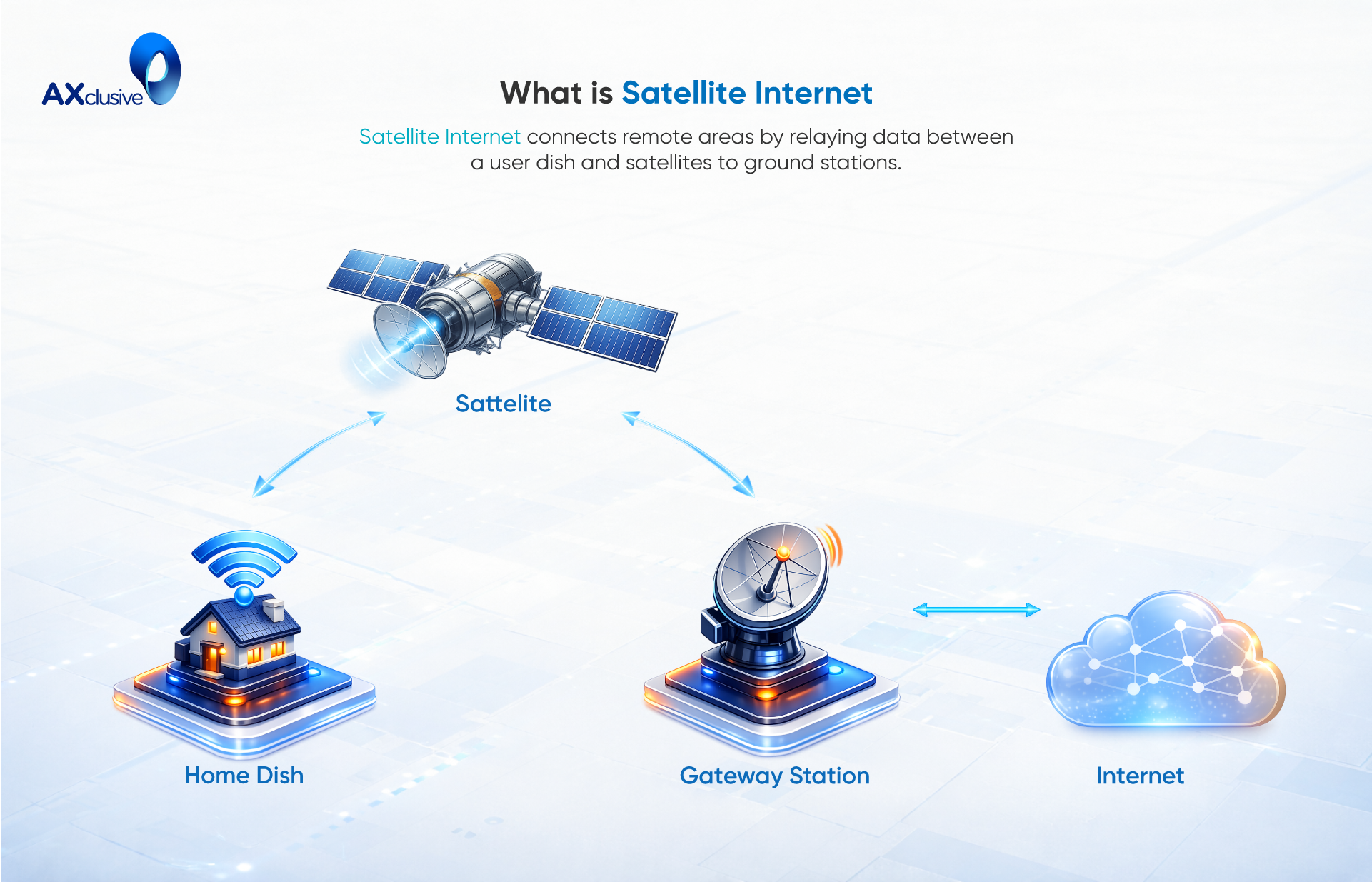
Satellite internet is a broadband service that delivers internet connectivity through satellites positioned in orbit around the Earth. Instead of using physical cables, data is transmitted as radio signals between a ground station, an orbiting satellite, and a satellite dish installed at the user’s location. This communication loop enables devices to send and receive data without relying on terrestrial network infrastructure.
Satellite internet is especially valuable in rural and remote regions where fiber, cable, or DSL services are unavailable. Advances in satellite technology have increased available speeds and improved reliability, making modern satellite services suitable for everyday online activities. However, because signals travel long distances through space, latency can still vary and may be influenced by environmental factors such as weather.
Satellite Internet Terminology
Understanding common satellite internet terms makes it easier to evaluate service quality and choose the right connection. The key terms below explain how satellite internet works and how it compares to other access technologies.
- Latency: Latency refers to the delay between sending a request and receiving a response. In satellite internet, latency is influenced by the long distance signals travel between Earth and orbiting satellites. Lower latency results in more responsive connections.
- VPN (Virtual Private Network): A VPN encrypts internet traffic and hides a user’s IP address. It adds a layer of privacy but may affect performance on satellite connections due to additional processing and routing.
- ISP (Internet Service Provider): An ISP is the company that delivers internet access and manages network infrastructure. Satellite ISPs operate ground stations and satellite networks that connect users to the wider internet.
- Mbps (Megabits per second): Mbps is the standard unit used to measure internet speed. It indicates how much data can be transferred each second. Higher Mbps supports smoother streaming, downloads, and online applications.
- Wi-Fi: Wi-Fi describes how devices connect wirelessly within a home or office. It does not determine how the internet reaches the location. Satellite, cable, or fiber connections can all use Wi-Fi for local access.
- VoIP (Voice over Internet Protocol): VoIP allows voice calls to be made over an internet connection instead of traditional phone lines. Its quality depends on internet stability, making it more sensitive to latency and outages in remote areas.
- DSL (Digital Subscriber Line): DSL is a broadband technology that delivers internet over telephone lines. It is generally slower than cable or fiber but allows simultaneous phone and internet use. DSL differs from older dial-up services and remains a common alternative where newer infrastructure is unavailable.
How Satellite Internet Works
Satellite internet works by sending data between a user’s satellite dish and a satellite orbiting the Earth. When a user requests online content, the data is transmitted from the dish to the satellite, which then forwards the signal to a ground-based network operations center connected to the global internet. The response follows the same path back to the user, completing the communication cycle.
For the connection to function properly, the satellite dish must maintain an unobstructed view of the satellite. Physical barriers such as buildings, trees, or terrain can interfere with signal transmission. Even with this limitation, satellite internet remains a practical and dependable solution for providing connectivity in remote or underserved locations where wired broadband infrastructure is not available.
Satellite Internet Pros and Cons
Satellite internet provides a practical connectivity solution where traditional broadband is unavailable. While it offers broad coverage and flexible deployment, it also presents technical and cost-related trade-offs. Understanding both sides helps users and organizations determine whether satellite internet meets their needs.
Benefits of Satellite Internet
- Wide availability: Satellite internet can be deployed in rural, remote, and hard-to-reach locations where cable or fiber networks do not exist.
- Rapid deployment: Installation does not require extensive ground infrastructure, allowing services to be activated faster than many wired alternatives.
- Infrastructure resilience: Because it does not rely on underground or pole-mounted cables, satellite internet is less affected by physical damage to local infrastructure.
- Scalable coverage: Satellite networks can support additional users without major changes to local installations, making expansion easier.
- Global reach: Satellite systems provide internet access across large geographic regions, including international and maritime environments.
Limitations of Satellite Internet
- Higher latency: Data must travel long distances between Earth and space, which results in slower response times compared to wired connections.
- Weather impact: Heavy rain, storms, or atmospheric conditions can interfere with signal quality and reduce performance.
- Usage limits: Many satellite plans include data caps or usage policies that restrict high-volume activities.
- Higher cost:Equipment, installation, and service fees are often higher than those of terrestrial broadband options.
- Specialized installation:Satellite internet requires professional setup and dedicated hardware to ensure proper alignment and signal quality.
Satellite Internet FAQ
Is satellite internet better than WiFi?
Satellite internet and WiFi are not the same and serve different purposes. Satellite internet refers to how internet access is delivered to a location, while WiFi is a local wireless method for connecting devices inside a home or office. Satellite internet can provide connectivity where other services are unavailable, but WiFi quality depends on the local router and network setup.
Does rain affect satellite internet?
Yes, heavy rain or severe weather can affect satellite internet performance. This phenomenon, known as rain fade, can weaken the signal between the satellite dish and the satellite, leading to slower speeds or temporary interruptions.
What are the downsides of satellite internet?
The main disadvantages include higher latency, sensitivity to weather conditions, data usage limits, and higher costs compared to wired broadband options. These factors can impact real-time applications and heavy data use.
Is satellite internet worse at night?
Satellite internet performance can slow down during peak evening hours. More users are typically online at night, which can increase network congestion and reduce available bandwidth, resulting in slower speeds.
Satellite internet continues to serve as an essential connectivity solution where traditional broadband cannot reach. By understanding what is satellite internet, its operation, and its limitations, users can better evaluate whether it fits their needs. Throughout this article, we examined how satellite technology enables access across remote locations and supports critical communication. As connectivity demands grow worldwide, satellite internet remains a key part of expanding reliable internet access.
Back to blog