
What Is RTT in Networking? Understanding Round Trip Time
RTT in networking, or round trip time, measures how long it takes for data to travel from a source to a destination and back again. It is a key metric used to evaluate network responsiveness and overall performance. Join Axclusive ISP to learn more about RTT in networking in the article below.
What is RTT in Networking?
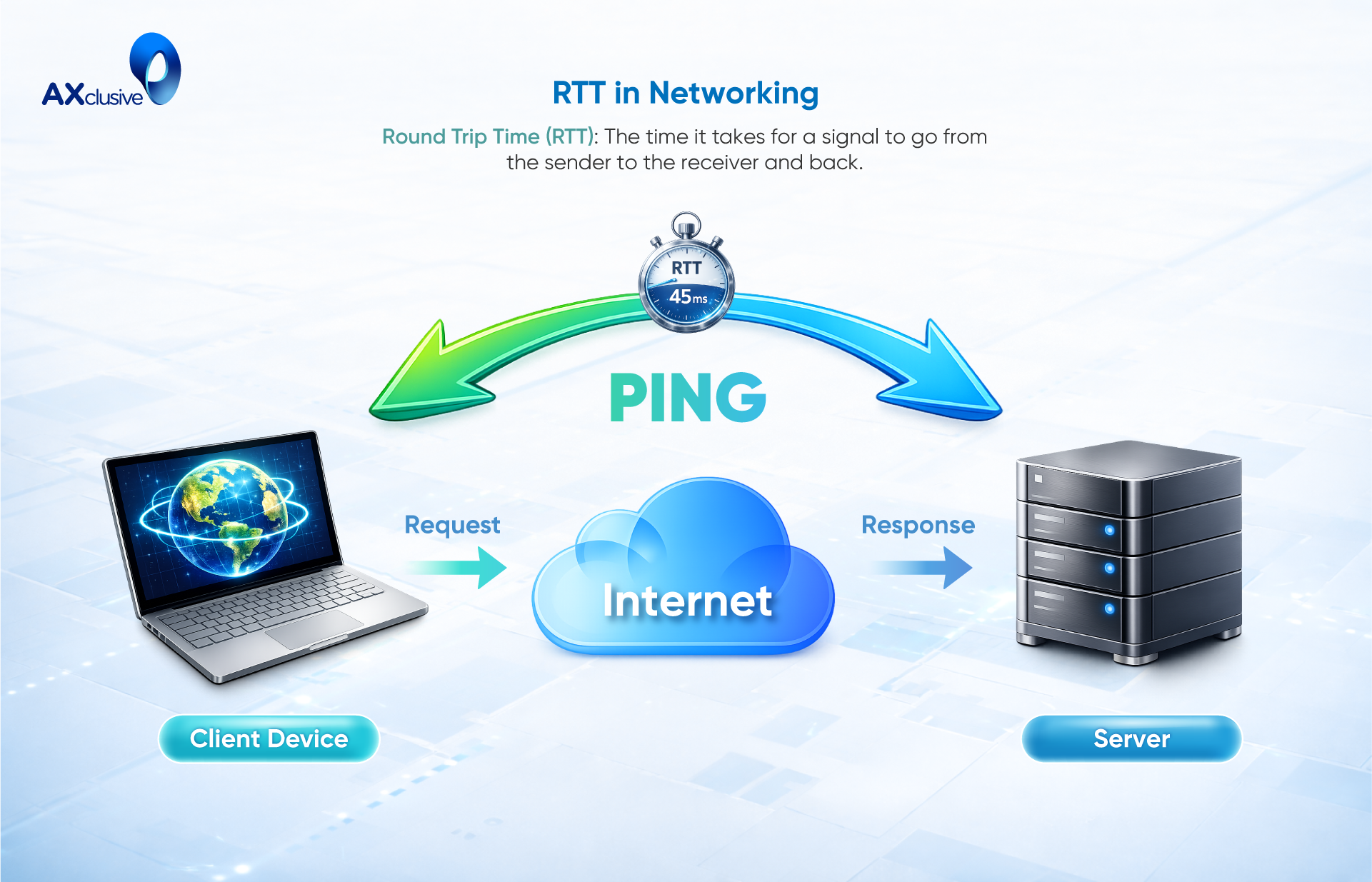
Round-trip time (RTT) in networking is a measurement of how long it takes for a data request to travel from a source device to a destination system and return with a response. It represents the full communication cycle between a client and a server, including transmission across the network and response delivery. RTT is commonly measured in milliseconds and is used to assess how responsive a network or application is. Lower RTT values indicate faster feedback and smoother application interactions, while higher RTT values often result in noticeable delays for users.
How RTT in Networking Works
Round-trip time describes the full duration of a data exchange between two endpoints in a network. It measures how long a request takes to leave the source, reach the destination, and return with a response. This metric reflects the responsiveness of a connection rather than the volume of data transferred.
For example, when a user in one geographic region sends a request to a server located far away, the data must pass through multiple network devices across different physical locations. Each router, transmission link, and processing step adds a small delay. Once the destination server receives the request, it processes it and sends a response back along the network path to the original user. The total elapsed time for this entire exchange is the round-trip time.
It is important to understand that RTT is an approximation, not a fixed value. Network paths can change due to routing decisions, congestion, or infrastructure conditions. As a result, RTT can vary from one request to the next. Despite this variability, RTT remains a key indicator for evaluating whether a connection is responsive and how long a typical request-response cycle is likely to take.
Factors Affecting RTT in Networking
Round-trip time describes the full duration of a data exchange between two endpoints in a network. It measures how long a request takes to leave the source, reach the destination, and return with a response. This metric reflects the responsiveness of a connection rather than the volume of data transferred.
For example, when a user in one geographic region sends a request to a server located far away, the data must pass through multiple network devices across different physical locations. Each router, transmission link, and processing step adds a small delay. Once the destination server receives the request, it processes it and sends a response back along the network path to the original user. The total elapsed time for this entire exchange is the round-trip time.
It is important to understand that RTT is an approximation, not a fixed value. Network paths can change due to routing decisions, congestion, or infrastructure conditions. As a result, RTT can vary from one request to the next. Despite this variability, RTT remains a key indicator for evaluating whether a connection is responsive and how long a typical request-response cycle is likely to take.
Factors Affecting RTT in Networking
Several technical and physical conditions influence round-trip time in networking. RTT is affected by both the network path and the systems involved in processing traffic. The main factors include the following:
- Transmission medium: The type of connection used has a direct impact on RTT. Fiber-optic links typically deliver lower latency than copper cables. Wireless connections introduce additional delay due to signal processing, while satellite links add significant latency because of the long distance signals must travel.
- Local network load: Traffic levels within a local area network can slow down requests before they reach external networks. High internal usage, such as multiple users streaming or transferring large files, can increase RTT even when the wider internet is not congested.
- Server processing time: RTT includes the time a destination system needs to handle a request and generate a response. When servers are under heavy load or experiencing attacks, response times increase, which raises overall round-trip time.
- Number of network hops and congestion: Data often passes through multiple intermediate devices on its way to a destination. Each additional hop adds delay. Congestion at any of these points can further slow packet delivery and increase RTT.
- Geographic distance: Physical distance remains a fundamental limitation. Data cannot travel faster than the speed of light, so longer distances result in higher RTT. Content delivery strategies such as caching and edge deployment help reduce this effect by placing data closer to users.
How to Reduce RTT in Networking
Round-trip time (RTT) can be reduced by optimizing how and where data is delivered to users. One of the most effective approaches is using a content delivery network (CDN). CDNs consist of distributed servers positioned close to end users, which shortens the distance data must travel and improves response times. CDNs reduce RTT through three main mechanisms:
Caching
Caching stores commonly requested content at locations closer to users. When a request is made for the first time, the origin server delivers the response and stores a copy at a nearby edge location. Subsequent requests for the same content are served directly from the cache. This avoids repeated trips to the origin server and significantly lowers RTT.
Load distribution
CDNs spread incoming requests across multiple servers instead of sending all traffic to a single destination. Requests are routed to servers based on proximity, availability, and current load. This prevents overload, reduces processing delays, and keeps response times consistent.
Scalability
CDNs are designed to handle large volumes of traffic. As demand increases, additional resources are made available automatically. This prevents congestion and ensures that response times remain stable, even during traffic spikes.
Measuring RTT in Networking
Round-trip time (RTT) can be estimated or measured using both theoretical calculation and practical network tools. Understanding both approaches helps network teams interpret latency results more accurately.
RTT represents the time required for a request to travel from a client to a destination and return with a response. In its simplest form, RTT can be approximated by focusing on propagation delay, which is the time it takes for data to move across the network path.
While RTT consists of several components—such as propagation delay, processing delay, queuing delay, and encoding delay—propagation delay is usually the dominant factor. Processing and queuing delays are often minimal under normal operating conditions.
A practical approximation for RTT is: RTT ≈ 2 × propagation delay
This estimate assumes that the request and response travel similar paths. It provides a useful baseline when evaluating network distance and link performance.
It is also important to recognize that loading a web page typically requires multiple requests. Each image, script, or external resource triggers its own request-response cycle. As a result, total page load time is influenced by RTT multiplied across many individual transactions, not just a single round trip.
RTT in Networking FAQ
What is a good RTT time?
A good RTT depends on the use case. For general web browsing, an RTT under 100 ms is considered acceptable. For real-time applications such as video calls, online gaming, or VoIP, an RTT below 50 ms delivers a better experience. Lower RTT values result in faster responses and smoother interactions.
Are RTT and ping the same?
RTT and ping are related but not the same. RTT is the measurement of round-trip time for a request and response in a network. Ping is a tool used to measure RTT by sending ICMP echo requests. In short, ping measures RTT, but RTT applies to all types of network communication, not just ping tests.
How accurate is the WiFi RTT?
WiFi RTT provides an estimate of round-trip time but is generally less precise than wired measurements. Wireless interference, signal strength, and device movement can affect results. While WiFi RTT is useful for general performance checks, it may fluctuate more than RTT measured over stable wired connections.
How to improve RTT performance?
RTT performance can be improved by reducing physical distance between users and servers, using content delivery networks (CDNs), optimizing routing paths, balancing traffic across servers, and reducing network congestion. Improving server performance and upgrading network infrastructure also help lower RTT.
RTT in networking plays a key role in determining how responsive and reliable a network feels to users. By understanding how round-trip time is measured and what factors influence it, network performance issues become easier to identify and address. Throughout this article, we explored why RTT matters for modern applications, cloud services, and real-time communication. With a clear view of RTT, organizations can make informed decisions to optimize network design, reduce latency, and deliver smoother digital experiences.
Back to blog